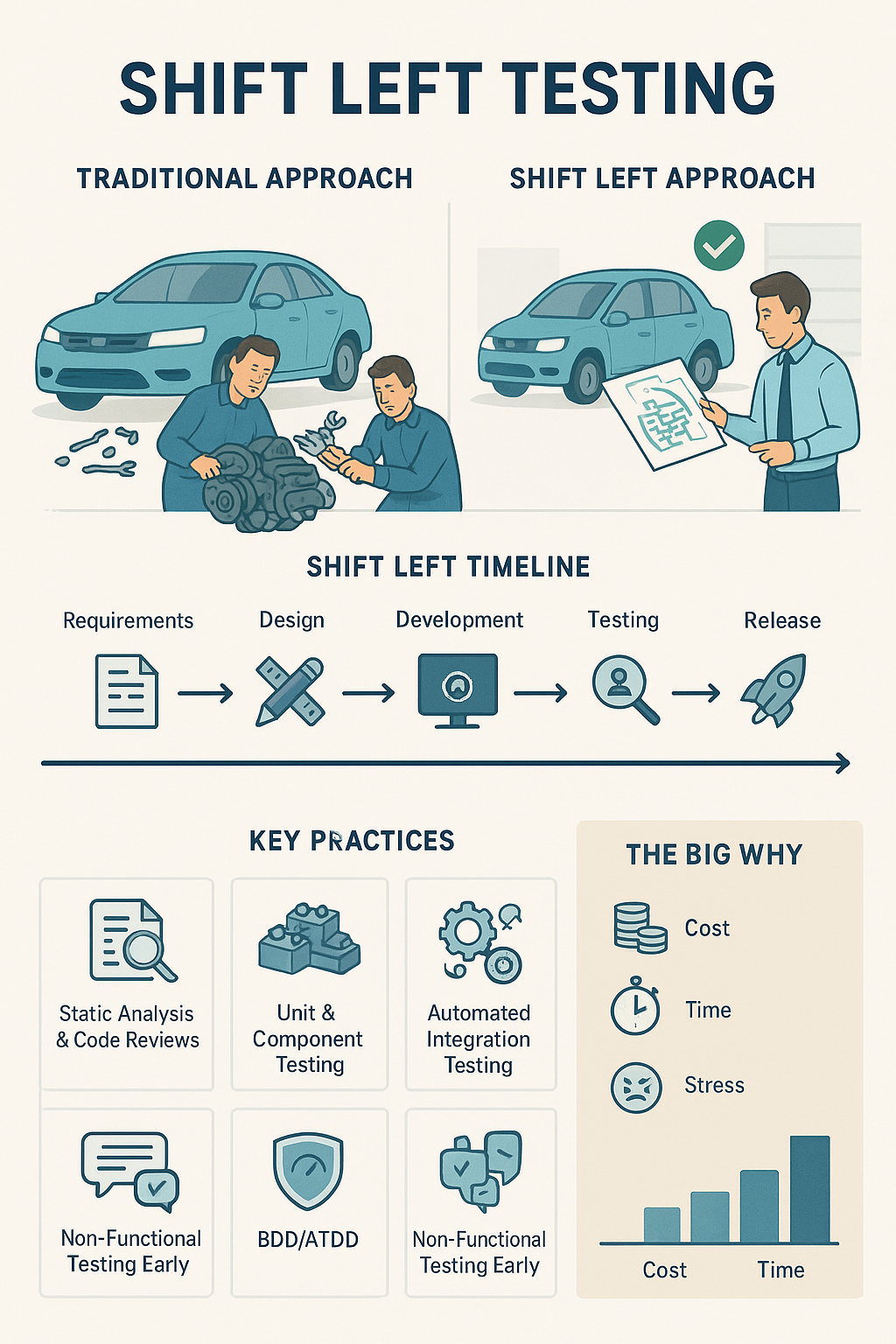
Imagine you’re building a car. You spend months designing the engine, the chassis, the interior, and the electronics. Everything looks perfect on paper. Then, after the entire car is assembled, you take it for a test drive and discover the engine is installed backward. Yikes! Now you have to take the whole car apart to fix one massive problem. It’s a huge, expensive headache.
Now, imagine a different scenario. As you’re designing the engine, you have an expert check your blueprint. They spot the mistake immediately. “Hey,” they say, “this engine won’t fit. You need to flip it around.” You make a tiny tweak to the design right then and there. Problem solved, no major rework needed.
This second scenario is the core idea behind Shift Left Testing. In the world of software development, it’s the practice of moving testing activities to the earliest possible stages of the software development lifecycle. Instead of waiting until the end to find problems, you start looking for them from the very beginning. It's about being proactive instead of reactive. This approach helps us catch defects when they are small, easy, and cheap to fix, before they grow into a full blown car engine level disaster.
Licensed by Preparesh
The Big Why: Why Shift Left Testing is a Game Changer
In traditional software development, testing often happens at the very end. Developers write code, and then the Quality Assurance (QA) team tests the completed application. This is what we call a “waterfall” approach. The problem? By the time a bug is found, a significant amount of work has already been built on top of the faulty code.
Finding and fixing a bug at this late stage is a nightmare for several reasons:
Cost: It’s incredibly expensive. The cost of fixing a bug increases exponentially the later it’s found. A bug found in the requirements phase might cost a few dollars to fix. That same bug found in production could cost thousands or even millions in lost revenue, reputation damage, and developer hours. Think of it as a domino effect. A small error in the first domino can topple the entire line.
Time: Reworking code is a slow process. Developers have to stop what they’re doing, go back, understand the old code, find the bug, fix it, and then retest. This delays new features and project timelines.
Stress: This back and forth between development and QA can create a lot of tension and stress within the team. Everyone is under pressure to meet deadlines while dealing with unexpected roadblocks.
Shift Left Testing is the antidote to all of this. By shifting testing activities "left" on the timeline, toward the start of the project, we find and fix issues much faster. This leads to higher quality software, happier teams, and more efficient development.
How to Shift Left: Key Techniques and Practices
Shift Left isn't just one single thing you do. It's a mindset and a collection of practices. Here's a look at some of the most important ones, explained with some fun examples.
1. Static Analysis and Code Reviews
This is one of the earliest forms of shifting left. It happens even before the code is executed.
Static Analysis: Imagine you have a grammar checker on your computer. It flags spelling errors, awkward sentences, and punctuation mistakes as you type, not after you finish writing the whole essay. Static analysis tools do the same for code. They scan the source code for potential bugs, security vulnerabilities, and style issues without actually running the program.
Example: A static analysis tool might spot that a variable is declared but never used, or that a function could potentially cause a memory leak. This happens the moment the code is written, allowing the developer to fix it on the spot. It’s like a super smart proofreader for your code.
Code Reviews: This is where developers review each other's code before it’s merged into the main codebase. It’s like having a friend read your important email before you send it to make sure it’s clear and professional. Another pair of eyes can often spot logic errors, typos, or better ways to write the code. This collaboration is a fantastic way to catch defects early and share knowledge.
2. Unit and Component Testing
This is the most fundamental level of testing a developer performs.
Unit Testing: A unit is the smallest testable part of an application, like a single function or a method. Think of a unit test as inspecting a single brick before you build the wall. A developer writes tests to verify that each individual brick is strong and functional on its own.
Example: You’re writing a function that calculates the total cost of items in a shopping cart. A unit test would check this function with different inputs: an empty cart (should return 0), a cart with one item, a cart with multiple items, and so on. This ensures the smallest piece of logic works exactly as intended, long before it’s connected to the rest of the application.
Component Testing: This is a step up from unit testing. It involves testing a group of related functions or a component in isolation. It’s like making sure all the bricks for a single window work together correctly before you build the entire house.
3. Early and Automated Integration Testing
Integration testing ensures that different parts of your application work together as expected. Traditionally, this was a manual, late stage activity. Shift Left advocates for automating this process and doing it much earlier.
Example: Let's say you have a front end (the website a user sees), a back end (the server that processes requests), and a database. An integration test would verify that when a user clicks “checkout” on the website, the back end correctly processes the order and saves the data to the database. By automating these tests, you can run them every time a new change is made, immediately catching any issues that break the connection between these components.
4. BDD and ATDD: Talking About Tests First
This is a powerful concept that involves writing tests before writing any code. It flips the traditional process on its head.
- Behavior Driven Development (BDD) and Acceptance Test Driven Development (ATDD) are collaborative approaches where developers, testers, and business stakeholders get together to define the application's behavior in plain, understandable language.
Example: Imagine you’re building a new login feature. Instead of just writing code, the team first sits down and writes a set of clear, testable scenarios:
Given I am on the login page,
When I enter my correct username and password,
Then I should be redirected to my profile page.
Given I am on the login page,
When I enter an incorrect password,
Then I should see an error message saying "Invalid credentials."
These scenarios become the tests. The developers then write the code that makes these tests pass. This ensures that everyone is on the same page about what the feature should do before a single line of code is written. It’s like getting a green light from everyone on the team before you start driving.
5. Non Functional Testing
Non functional requirements are things like performance, security, and usability. Shift Left means thinking about these things from the start, not just as an afterthought.
Example: Security vulnerabilities are often a huge and expensive problem to fix later. With a Shift Left approach, security scanning tools are integrated into the development pipeline. As a developer writes code, these tools automatically scan for common security issues. It’s like having a security guard standing watch as you build the bank vault, rather than hiring one after the vault is already built.
Shift Left in Practice: The Engineer’s Role
As an engineer, you play a vital role in making Shift Left happen.
Embrace Unit Testing: Don't view writing unit tests as a chore. See it as a way to prove your code works and as a safety net for future changes.
Participate in Code Reviews: Be open to having your code reviewed and take the time to review others’ code. It's an incredible learning opportunity.
Think Like a Tester: When you're designing a feature, ask yourself, "How could this break? What are all the weird inputs a user might try?" This proactive mindset is what Shift Left is all about.
Automate, Automate, Automate: Learn to write automated tests. The more you can automate, the faster you can find issues and the more time you’ll have to work on new features.
Shift Left Testing is more than just a buzzword. It's a fundamental shift in how we approach building software, prioritizing quality from the very beginning. By catching bugs early, we save time, money, and a lot of headaches, allowing us to build more robust and reliable applications!