Imagine you are a filmmaker trying to plan a new movie. You start with a big, high level idea, like "A detective solves a mystery in a futuristic city." That’s the movie's scenario. It's the overarching theme. Now, to actually make the movie, you need to write a detailed script with every line of dialogue, every camera angle, and every action laid out in precise detail.
In the world of software quality assurance, test scenarios and test cases follow this exact same dynamic. They are both essential tools for testers, but they serve very different purposes. A test scenario is the high level idea, while a test case is the detailed script. Understanding the difference is crucial for any engineer learning the ropes of software testing.
Licensed by Preparesh
The Big Picture: What is a Test Scenario?
A test scenario is a high level, one line description of a feature to be tested. It answers the question, "What do we need to test?" It's a broad statement that encapsulates a possible user interaction or system behavior.
Think of it as the title of a chapter in a book, or a single goal in a video game. It's not concerned with the "how" just yet, but with the "what." Test scenarios are typically derived directly from the business or functional requirements of the software.
Why are test scenarios so important?
Scope Coverage: By creating a list of scenarios, you ensure that you are covering all the major functionality of the application. It acts as a checklist for your testing.
Clarity: It provides a common understanding between testers, developers, and business stakeholders about what features are being validated.
Efficiency: They are quick and easy to create, which is a huge benefit during the early stages of a project when requirements might still be changing.
Example: Let's say we are building an e commerce website. A few of our test scenarios might be:
Verify a user can log into their account.
Verify a user can search for a product.
Verify a user can add a product to their shopping cart.
Verify a user can complete a purchase.
These are simple, high level statements that guide the rest of the testing process. They tell us what areas of the application need our attention.
The Detailed Instructions: What is a Test Case?
A test case is a detailed set of instructions that a tester will follow to validate a specific functionality. It is the granular, step by step script that brings the test scenario to life. It answers the question, "How exactly will we test this?"
A single test scenario can have multiple test cases. Each test case will focus on a specific path, or a specific set of inputs, for that scenario.
A good test case typically includes:
Test Case ID: A unique identifier.
Test Case Title: A brief, descriptive title.
Preconditions: What needs to be in place before you can start the test?
Test Steps: A clear, numbered list of actions to take.
Test Data: Any specific data to be used, like a username and password.
Expected Result: The correct outcome of the test. What should happen when you follow the steps?
Example: Let's take the scenario "Verify a user can log into their account." This scenario could generate many test cases, each with its own set of detailed steps.
Test Case 1: Login with Valid Credentials
Preconditions: A user account with a valid username and password exists.
Steps:
Navigate to the login page.
Enter a valid username in the username field.
Enter a valid password in the password field.
Click the "Login" button.
Expected Result: The user is successfully logged in and is redirected to their dashboard.
Test Case 2: Login with Invalid Password
Preconditions: A user account with a valid username exists.
Steps:
Navigate to the login page.
Enter a valid username.
Enter an incorrect password.
Click the "Login" button.
Expected Result: An error message is displayed stating "Incorrect username or password."
As you can see, the single scenario has been broken down into multiple test cases, each focusing on a specific variation of the user's action.
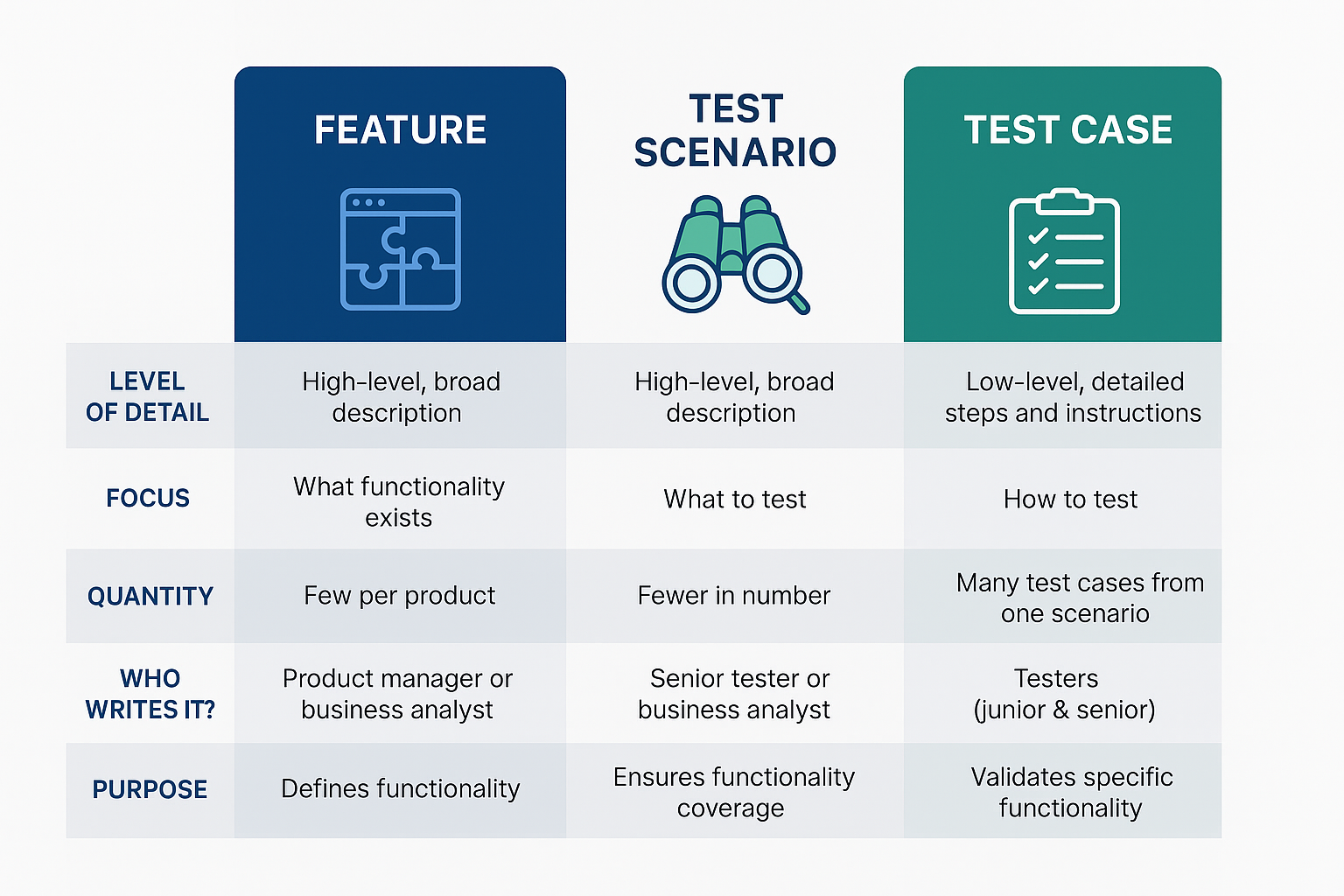
The Great Showdown: Test Scenarios vs. Test Cases
Let's summarize the key differences to make them crystal clear.
| Feature | Test Scenario | Test Case |
|---|---|---|
| Level of Detail | High level, broad description | Low level, detailed steps and instructions |
| Focus | What to test | How to test |
| Quantity | Fewer in number | Many test cases can be derived from one scenario |
| Who writes it? | Often written by a senior tester or business analyst | Written by testers, junior and senior alike |
| Purpose | To ensure all functionality is covered | To validate specific functionality with precision |
Analogy in Action: A Cooking Recipe
Let's use a cooking analogy to make this even more digestible.
Test Scenario (The Recipe Title): "Make a Chocolate Cake." This is the high level goal. It tells you what you are going to be making.
Test Case (The Recipe Steps): This is the detailed recipe itself.
Preheat oven to 350°F.
Mix one cup of sugar, one cup of flour, and two eggs.
Add one teaspoon of vanilla extract and one half cup of cocoa powder.
Pour the batter into a greased pan.
Bake for 30 minutes.
Cool and frost.
Each step is a clear instruction. If you follow these steps, you should get the "expected result" of a delicious chocolate cake.
Conclusion: Working Together for Quality
Test scenarios and test cases are not competing concepts; they are two sides of the same coin. Test scenarios provide the necessary high level overview to ensure all bases are covered. They are an excellent tool for communicating with non technical stakeholders and for estimating the scope of work. Test cases, on the other hand, provide the granular detail needed for precise execution and for creating a reproducible record of testing activities.
As an engineer, you'll likely start by writing test cases based on pre existing scenarios. Over time, as you gain more experience, you'll be involved in creating the scenarios themselves. By mastering both of these concepts, you'll be well on your way to becoming a skilled and invaluable member of any quality assurance team.