Imagine you are planning a massive, cross country road trip. Your goal is to drive from New York to California. Before you even get in the car, you need two very important documents: a road trip strategy and a road trip plan.
Your road trip strategy is the big picture. It's the high level vision for the entire journey. It would say something like: "We will drive west, sticking to major highways to make good time. We will stop at national parks along the way to enjoy nature and break up the long drives." This document is broad, stable, and probably doesn't change much. It sets the overall tone and direction.
Your road trip plan, on the other hand, is the day to day, detailed itinerary. It would say: "On Monday, we will drive 8 hours from New York to Ohio. We will stay at the Marriott in Columbus and have dinner at a specific restaurant. We'll leave at 8 AM and arrive around 4 PM." This document is very specific, granular, and can change easily. If a road is closed or a friend recommends a better restaurant, you can update this plan without changing your overall strategy of driving west.
In the world of software development, a test strategy and a test plan work in exactly the same way. They are both vital for a successful testing effort, but they serve different purposes. Understanding the distinction is key for any engineer.
Licensed by Preparesh
The Big Picture: What is a Test Strategy?
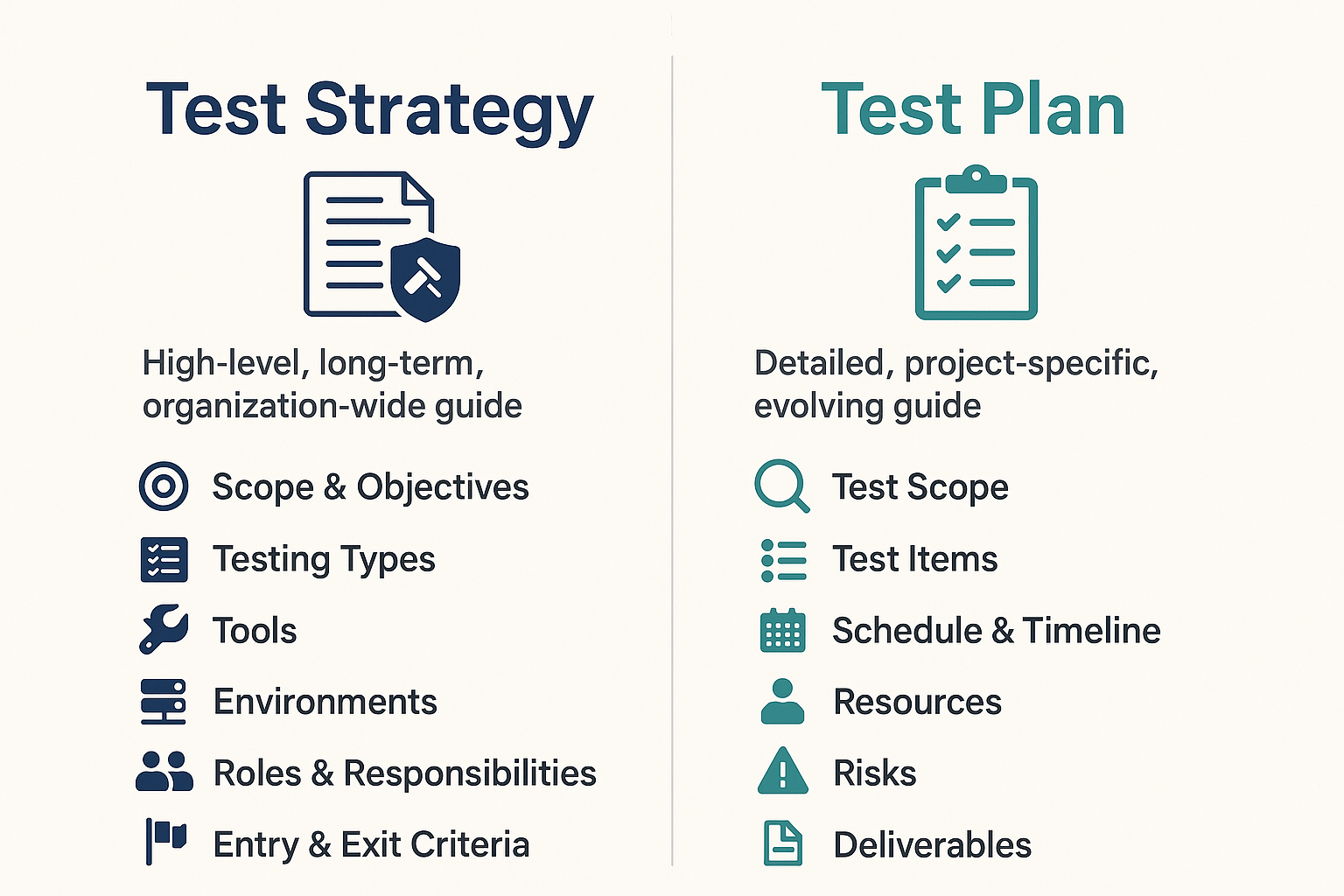
A test strategy is a high level document that outlines the overall approach to testing for a project or even an entire organization. It's a guiding document that answers the question, "What is our philosophy for testing this software?"
Think of it as the "Constitution" of your testing efforts. It's a permanent document that is usually created at the very beginning of the project life cycle, often by a Test Lead or Manager, and it rarely changes.
Key components of a test strategy include:
Scope and Objectives: What are we trying to achieve with testing?
Testing Types: What kinds of testing will we perform? For example, will we do performance testing, security testing, or user acceptance testing?
Testing Tools: What tools will we use for testing (e.g., a specific bug tracking system or a tool for automated testing)?
Testing Environments: What environments will we use for testing (e.g., a development environment and a production environment)?
Roles and Responsibilities: Who is responsible for what in the testing process?
Entry and Exit Criteria: When can we start testing a phase, and when can we stop?
A test strategy is meant to be a single source of truth for all testing related decisions. It provides consistency across all testing activities.
The Detailed Blueprint: What is a Test Plan?
A test plan is a project specific, detailed document that outlines the specific activities for a particular testing effort. It answers the questions: "Who, what, when, where, and how will we test this project?"
If the test strategy is the Constitution, the test plan is the specific legislation that brings it to life. A test plan is created for each new project or release. It is dynamic and can be updated as the project evolves.
Key components of a test plan include:
Test Scope: What specific features of this project will be tested?
Test Items: The specific features and functions to be tested.
Test Tasks: A list of all the tasks to be performed, such as creating test cases, executing tests, and logging bugs.
Schedule and Timeline: When will each testing task be completed?
Resources: Who on the team will be involved, and what hardware or software resources are needed?
Risks and Contingencies: What could go wrong, and what is our backup plan?
Test Deliverables: What will the team deliver at the end of the testing effort (e.g., a test report, bug logs)?
A test plan is a practical, day to day guide for the testing team. It is an active document that the team uses to manage their work.
The Great Showdown: Test Strategy vs. Test Plan
Let's summarize the key differences in a simple table.
| Feature | Test Strategy | Test Plan |
|---|---|---|
| Level of Detail | High level, broad document | Low level, highly detailed document |
| Scope | Project or organizational wide | Project or release specific |
| Creator | Test Lead or Manager | Test Lead or Manager |
| When to create? | At the beginning of the project life cycle | For each new project, release, or testing phase |
| Dynamic? | Stable, rarely changes | Dynamic, can be updated frequently |
| Purpose | Defines the "what and why" of testing | Defines the "who, when, where, and how" of testing |
Analogy in Action: A Home Renovation
Let's bring our analogy to life with a home renovation project.
Test Strategy (The Renovation Strategy): The homeowner and contractor decide on the overall vision. "Our strategy is to completely renovate the kitchen and modernize the living room. We will use eco friendly materials and hire professional contractors for all electrical and plumbing work." This is the high level, unchangeable vision. It dictates the fundamental principles of the project.
Test Plan (The Renovation Plan for the Kitchen): The contractor creates a detailed plan just for the kitchen. It says: "Day 1: Demolish old cabinets and counter. Day 2: Install new plumbing. Day 3: Install new electrical wiring. John and Sarah will be responsible for the demolition. We will need a dumpster on site by Tuesday." This is a day to day, highly specific document that can be changed. If the plumbing work takes longer than expected, the contractor can adjust the schedule in the plan without changing the overall strategy of renovating the kitchen.
Conclusion: Working Together for Quality
Both the test strategy and the test plan are crucial for a successful testing effort. The test strategy provides the overarching vision and direction, ensuring that all testing activities are aligned with the project's goals. The test plan provides the detailed, actionable steps that the team will take to execute that strategy.
As an engineer, you'll likely work directly with a test plan, but it's important to understand that it is rooted in a larger, more stable test strategy. Together, these two documents form a powerful blueprint for quality, guiding the team to build and deliver software that is reliable, robust, and free of defects.