When I first started working in data, I was overwhelmed by the number of tools out there. My first job used Amazon Redshift, and I spent days learning how to load data and optimize queries. Later, I joined a team that relied on Google BigQuery for fast analytics, and eventually, I found myself working with Snowflake, which seemed to be everyone’s new favorite. Each platform had its own quirks, and switching between them taught me a lot about what makes each one unique.
If you’re preparing for data roles or want to understand these platforms better, here’s a breakdown of Redshift, BigQuery, and Snowflake—along with some lessons I picked up along the way.
Amazon Redshift
What it is:
Redshift is Amazon’s cloud data warehouse, designed for large-scale data storage and analysis. It’s tightly integrated with the AWS ecosystem.
What I noticed:
At my first job, Redshift felt familiar because it uses SQL, but managing clusters and tuning performance was a big part of the work. It’s powerful, but you need to pay attention to how resources are allocated.
Key points:
Best for: Companies already using AWS services.
Setup: Cluster-based; you manage nodes and performance.
Scaling: Manual (you resize clusters as needed).
Pricing: Pay for the resources you reserve, whether you use them or not.
Google BigQuery
What it is:
BigQuery is Google Cloud’s fully managed, serverless data warehouse. It’s designed for fast, ad-hoc analysis of massive datasets.
What I noticed:
When I switched to BigQuery, I was surprised by how little infrastructure I had to manage. I could focus on writing queries and analyzing data, and the platform handled scaling automatically.
Key points:
Best for: Teams that want simplicity and speed, especially for large or unpredictable workloads.
Setup: Serverless; no clusters to manage.
Scaling: Automatic.
Pricing: Pay per query and storage used.
Snowflake
What it is:
Snowflake is a cloud-native data warehouse that runs on AWS, Azure, and Google Cloud. It separates storage and compute, making it easy to scale and share data.
What I noticed:
Snowflake made it easy to collaborate across teams and clouds. I liked how I could scale up compute for heavy jobs and scale down when not needed, without affecting storage.
Key points:
Best for: Organizations needing flexibility, multi-cloud support, or easy data sharing.
Setup: Serverless; storage and compute are separate.
Scaling: Automatic and independent for storage/compute.
Pricing: Pay for what you use (storage and compute billed separately).
How I’d Approach This in an Interview
If someone asked me which I prefer, I’d say:
“I’ve worked with all three. Redshift is great if you’re already invested in AWS and want control over your environment. BigQuery is ideal for quick, large-scale analytics without worrying about infrastructure. Snowflake stands out for its flexibility and ease of sharing data across platforms. My choice depends on the company’s existing tools and business needs.”
Quick Comparison Table
| Feature | Amazon Redshift | Google BigQuery | Snowflake |
|---|---|---|---|
| Cloud | AWS | Google Cloud | AWS, Azure, Google Cloud |
| Setup | Cluster-based | Serverless | Serverless |
| Scaling | Manual | Automatic | Automatic (independent) |
| Pricing | Pay for provisioned | Pay per query & storage | Pay for storage & compute |
| SQL Support | PostgreSQL-like | Standard SQL | ANSI SQL |
| Best For | AWS users, control | Fast analytics, ease | Flexibility, sharing |
| Data Sharing | Limited | Limited | Native, easy |
| Multi-cloud | No | No | Yes |
| Popular Use | Traditional BI, ETL | Ad-hoc, big data | Collaboration, multi-cloud |
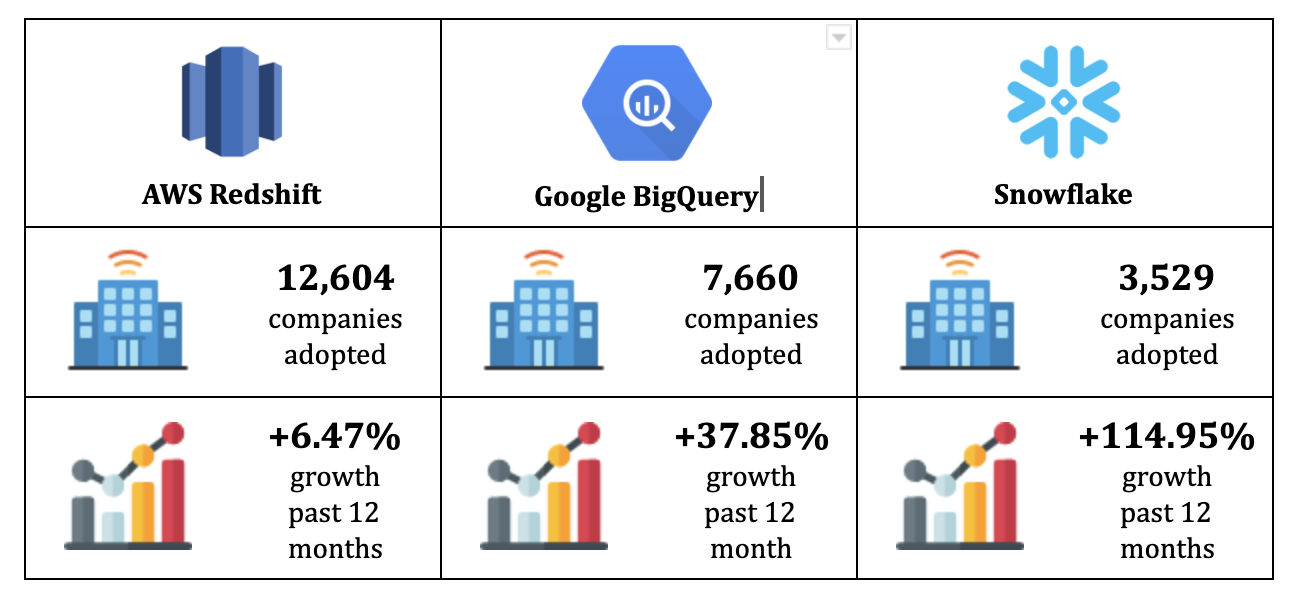
What Should You Learn First?
Check job postings: If a company uses AWS, start with Redshift. If it’s Google Cloud, try BigQuery. If you see “multi-cloud” or “data sharing,” Snowflake is a good bet.
Try free tiers: All three offer free or trial versions. Experiment with a small project to get a feel for each.
Be ready to discuss trade-offs: Interviewers appreciate when you can explain not just what you know, but why you’d choose one tool over another.
Switching between these platforms taught me that it’s less about memorizing every feature, and more about understanding the strengths of each and being able to adapt. If you can share your experience and reasoning, you’ll stand out in interviews.